
Encryption that keeps your data truly yours
At Lexo Office, encryption is not an extra feature. It is the foundation of protecting your legal data.
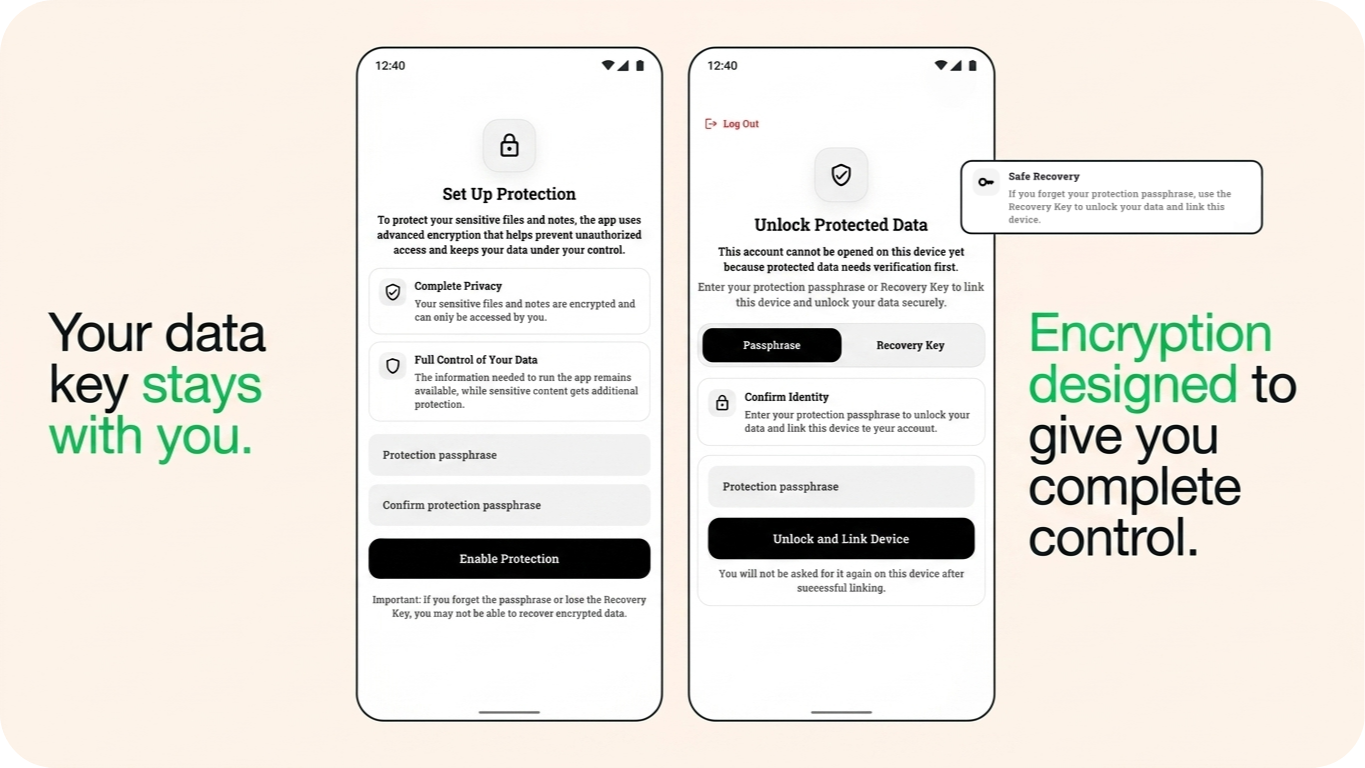
Because your legal files are not just data
Legal information contains cases, client information, documents, and private notes. Lawyers need a higher level of privacy – Lexo Office considers encryption a core part of the product, not an optional feature.
Protection that starts from your device
When users subscribe to Silver or Elite plans, the app asks them to create an encryption password. This password is not the login password – it is the key that protects the user's legal data.
Key difference: Login vs Encryption password
🔐 Login Password
Used to access the account. Confirms user identity.
🔑 Encryption Password
Protects the actual data. Required to decrypt and read information.
Your data is encrypted before leaving the app
When the user creates cases, client records, documents, or notes – the application encrypts the data before sending it. The database receives encrypted information only. The original readable data is not stored directly.
How your data moves inside Lexo Office
- Mobile Application
- Data Encryption
- Encrypted Connection
- Encrypted Database
And the reverse process: Encrypted Database → Application → Encryption Key → User. Decryption happens inside the application.
Nobody can read your data
Because data is stored encrypted: developer cannot read it, system administrator cannot read it, unauthorized person cannot read it – database access alone is not enough. Lexo Office does not have the ability to read user data.
Even if the account is compromised
If someone gets username and login password, they still cannot access the legal files – because the encryption password is required. Your legal work stays protected.
Recovery key
When creating encryption password, the application creates a recovery key. The user must keep it safe. Important: If the user loses both encryption password and recovery key, the encrypted data cannot be recovered. This is a security principle, not a limitation.